Víctor IBARRA (Guadalajara, 1978)
Member of the National System of Art Creators / 1st Prize at the Basel Composition Competition (2017)
Grande Équerre, ensayo sobre la negación (2014)
Grande Équerre, essay on negation (2014)

 Watch Concert I
Presentation by Víctor Ibarra and Josetxo Silguero (soloist SIGMA Project).
Concert: Grande Équerre, ensayo sobre la negación (2014)
Conversation between Jose Luis Castillo (director of Ensemble Cepromusic from Mexico) and Victor Ibarra (composer).
Musical Tip: The versatility of today’s saxophonist. Alberto Chaves (soloist SIGMA Project)
Grande Équerre: ensayo sobre la negación (2014) for saxophone quartet.
Commissioned work: SIGMA Project with support from FONCA (Mexico) and Casa Velázquez (France).
World premiere: 12/XI/2014, El Colegio Nacional (Mexico City).
Grande Équerre: essay on negation (2014) is the last of a series of pieces I wrote around the work of Antoni Tàpies. In this particular piece, I try to decode in sounds the analysis made by architect Juan José Lahuerta about Grande Équerre (1962), a painting that was painted just when the Catalan artist was reaching one of his first highlights on the international scene. The painting exhibits some of the attributes that make Tàpies‘ painting refer us “exemplarily to a language already established and converted into a system“: the achromy, the evidence of the design, the exhibition of his matter, the symbolism or the negation. In vertical format and with dimensions of 195 × 130cm “the size of the bed or the box corresponding to the man who, standing in front of it, confusing his limbs with the cross, interrogates it“, Tàpies masterfully places us in front of a kind of intimate encounter with the lugubrious form of the crucified.
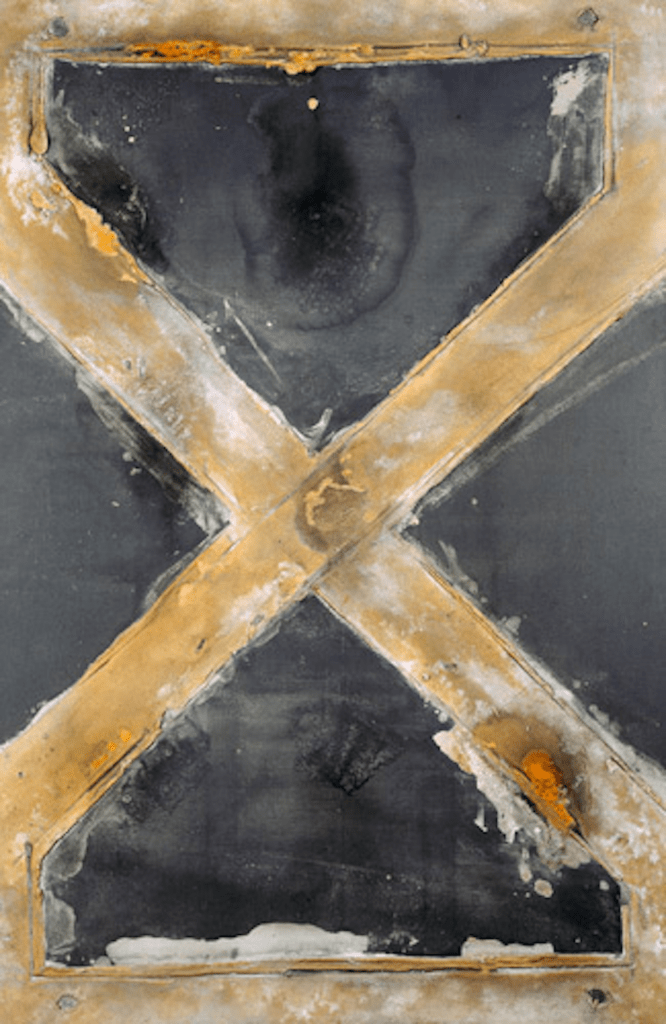
In a second encounter with this painting —and which is where the conception of the score in question is primarily derived from— architect Juan José Lahuerta proposes an “impression” of the triple negation. The first: where the painting symbolizes a wooden frame with worn planks, nail holes in the four corners; a painting hung upside down where the obverse succumbs to the reverse and the visual to the tactile. The second negation, shorter: where we stumble upon the X, symbol of the crossed out, the negation itself or superstition. Here we find boards that cannot be crossed, where we may only know the reverse side of the painting and where on the other side there would be no painting, “perhaps stains or debris and even cobwebs“. Finally, the third negation, even shorter (as in a sort of canned spiral): the painting as a window through which we see the stories that, as in the case of the window, would serve to look out; always through an X, a wall where on the other side there would perhaps only be nothingness.
+ info: Víctor Ibarra
Next Concert: José Manuel López López →